
On 21 August 2025, the Rajya Sabha passed the Promotion and Regulation of Online Gaming Bill. Within hours, MPL, Zupee, Dream Sports, Gameskraft and Probo suspended their real-money games. WinZO and PokerBaazi followed the next day. MPL stopped taking deposits but let users withdraw their balances.
A product can change overnight. A database rarely does. Unless someone ran a deletion programme, the old business still sits in production tables, warehouses and backups. That means PAN and bank details, UPI handles, KYC images, wallet ledgers and years of withdrawal tickets.
The free games that replaced cash contests reach a different audience. Money games put identity checks in front of every payout. A free casual game has no such gate unless the company builds one, so children can sign up as easily as adults. From 13 May 2027, Section 9 of the DPDP Act governs every one of them.
The work, then, is data discovery with a sharper edge than usual. You have to find both estates and separate them. Then you tag every data set by age and by the rule that decides how long it lives.
Where things stand
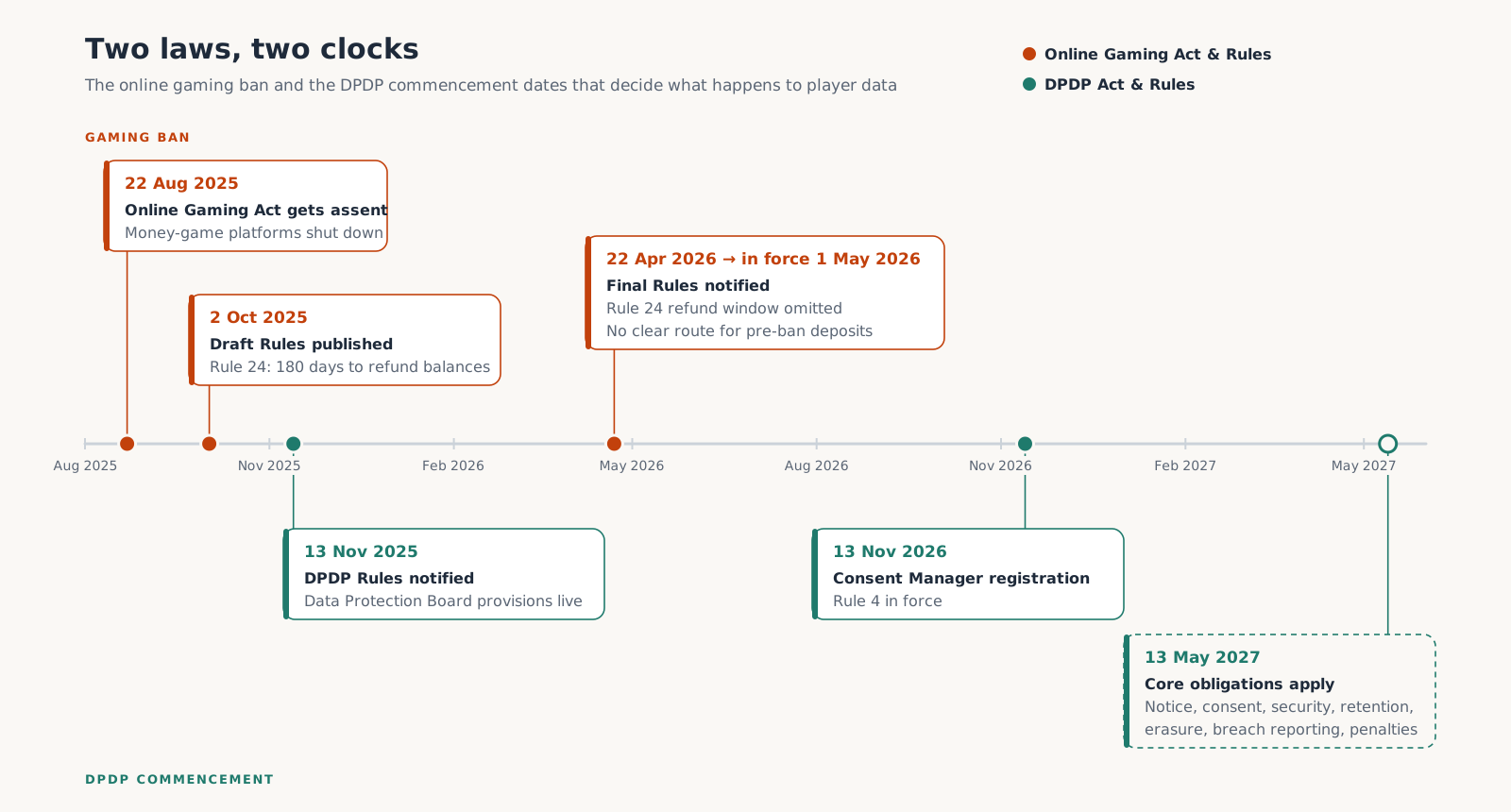
The gaming Act received presidential assent on 22 August 2025. Its prohibition came into force only on 1 May 2026, together with the Promotion and Regulation of Online Gaming Rules, 2026. MeitY notified those Rules on 22 April 2026. The industry stopped about eight months before the law required it to.
The DPDP clock runs separately. The DPDP Rules, 2025 were notified on 13 November 2025. Sections 8 and 9 of the DPDP Act, and Rules 6, 8 and 10, commence eighteen months later, on 13 May 2027. Our piece on working back from 13 May 2027 sets out the wider timetable.
On 5 October 2026, MeitY made the DPDP (Removal of Difficulties) Order, 2026. It inserted the word "of" in Section 9(1) and changed "audit" to "data audit" in Section 10(2)(c)(ii). Practitioners read both changes as textual, with no new duty. Your Section 9 plan stands as it was.
One change in the gaming Rules matters more for data. The draft Rules of 2 October 2025 carried a Rule 24. It gave platforms 180 days to refund balances, deposits and winnings without that counting as facilitating a money game. The notified Rules omitted it. Lawyers now say pre-ban deposits have no clear refund route.
The real-money archive: what still justifies keeping it
Section 8(7)(a) is blunt. A Data Fiduciary must erase personal data once it is reasonable to assume the specified purpose is no longer served. The only general exception is retention that another law requires. The purpose behind a player's PAN, bank account and KYC selfie was to run money games and pay winnings. For most players, that purpose ended in August 2025.
The DPDP Act offers no "legitimate interests" ground to fall back on. That is one of the claims about the Act that are wrong. Each record needs a specific reason to survive. Three reasons hold up.
Unpaid balances. Some users still have money on the platform. In November 2025, the Enforcement Directorate said WinZO still held ₹43 crore that it hadn't refunded after the ban. It also said Gameskraft held over ₹30 crore in escrow. Paying a user back needs her identity and her bank or UPI details. For her, the original purpose hasn't ended. Keep her wallet ledger, payout details and the KYC record that proves who she is. Keep nothing else.
Legal holds. ED searched Gameskraft premises in Bengaluru and Delhi-NCR from 7 to 13 May 2026 and froze ₹526 crore. Taxscan reported that the searches seized documents and electronic records. When a summons, notice or court order covers a data set, keep it. Section 17(1) exempts processing for investigating offences or enforcing legal claims from most of Chapter II. Sections 8(1) and 8(5) still apply, and Section 8(5) breaches carry penalties of up to ₹250 crore. A hold justifies keeping data. It doesn't relax security.
Scope each hold to the users, dates and systems it names. A notice about one game in one year doesn't freeze the whole archive.
A law that names a period. Section 8(7) gives way where another law requires retention. Tax, GST and company records are the usual candidates. Write the provision and its period against each data set. A vague sense that finance may need it someday is not a provision.
Everything outside these three goes. That includes KYC images of users with zero balance and no hold. It also covers closed withdrawal tickets and marketing lists built from cash-game players. Erase them, and keep a record of what you erased and when.
Children in the free-to-play estate
Section 2(f) defines a child as anyone under 18. Section 9(1) requires verifiable parental consent before processing any personal data of a child. Section 9(2) bars processing likely to harm a child's well-being. Section 9(3) bars tracking, behavioural monitoring and targeted advertising directed at children.
Rule 10 sets the parent check. The platform must confirm that the person claiming to be the parent is an identifiable adult. It can rely on reliable identity and age details it already holds. It can also use details the parent provides, or a virtual token from an authorised entity, including through DigiLocker. Your consent management flow must record which route you used for each child.
Here the archive creates a temptation. A former money-game company holds verified KYC for a large base of adults, and some are parents. Rule 10(1)(a) lets you rely on identity details you already hold. But those details were collected for money games. Using them for parent checks is a new purpose, and it needs fresh notice and consent from that adult. Don't keep the KYC archive alive on the theory that it might help with Rule 10 later.
The gaming Rules point the same way. PIB's note on the Rules lists age verification, age gating and parental controls among user safety features. Providers disclose these features when they apply for determination or registration. Build age assurance once, so it serves both laws.
The DPDP Rules leave room for that build. Part B of the Fourth Schedule exempts processing needed to confirm a user isn't a child. It also exempts processing that keeps harmful content or advertising away from her. Both exemptions are limited to the extent necessary.
SDKs and telemetry: where behavioural monitoring hides
Most teams start discovery with databases. For Section 9(3), the app build matters more. A free-to-play build can ship with an ad network, an attribution SDK, product analytics, crash reporting, push messaging and anti-cheat.
For each SDK, ask two questions. Does it build a picture of one player over time? Does that picture change what the player sees, is offered or is shown as ads? If both answers are yes and the player may be a child, treat it as tracking or behavioural monitoring.
On that test, ad personalisation and cross-app attribution must stop for child accounts. Engagement tuning must stop too, such as offers timed to play patterns or nudges after a lapse. ED's chargesheet against Gameskraft cited push notifications, SMS campaigns and telemarketing among the tools that drove addictive play. When the same tools run on a child's play data, they sit squarely inside Section 9(3). Crash reporting can stay if you strip identifiers and never join it to a player profile.
Two cases are harder. The gaming Rules list fair-play monitoring and time limits among user safety features. Both watch how a player behaves. The Fourth Schedule has no exemption that names anti-cheat. Our view is simple. Keep such monitoring narrow and use its output only for integrity and play limits. Keep it away from ad and engagement systems, and record your reasoning.
Three clocks on the same data
Three retention rules land on gaming data at once, often on the same tables.
| Rule | What it requires | Who it binds |
|---|---|---|
| Rule 8(1), Third Schedule | Erase three years after the user's last approach, or after the Rules commenced, whichever is later | Online gaming intermediaries with 50 lakh or more registered users in India |
| Rule 8(2) | Warn the user at least 48 hours before that erasure | Same class |
| Rule 8(3) | Keep personal data, traffic data and processing logs for at least one year, then erase | Every Data Fiduciary |
| Gaming Rules, Rule 17 | Keep traffic data and metadata on computer resources in India, as the Authority directs | Providers of online social games and e-sports |
Commencement is open to reading. The DPDP Rules commence in stages, starting 13 November 2025 and ending 13 May 2027. Decide with counsel which date starts your Third Schedule clock, and record the decision.
The 48-hour warning needs live contact data. Rule 8(2) says the user must be told erasure is coming unless she logs in or makes contact. A phone number from 2022 may no longer reach anyone. Route the notice and any reply through your rights request portal, so every response is logged.
The virtual token carve-out. The Third Schedule excludes data needed to let a user reach her account. It also excludes any platform-issued virtual token that can be used to get money, goods or services. In-game currency bought with real money is the obvious candidate. Be careful, though. The gaming Rules treat monetising in-game assets outside the game as a factor in deciding whether a game is a money game. If your tokens can be turned into money, retention is the smaller question.
Logs need a home in India. Rule 8(3) sets a one-year floor for logs and traffic data, for the purposes in the Seventh Schedule. Rule 6(1)(e) asks for the same year for security investigations. The gaming Rules add that traffic data and metadata must sit on computer resources in India. The Online Gaming Authority will set the period. Check where your log pipeline actually lands, including third-party observability tools.
How to run the discovery
Discovery here means more than a list of databases. Every data set must leave the exercise with three tags and a named owner.
- Inventory. Cover production databases, warehouses, backups and object storage holding KYC images. Include helpdesk attachments, CRM, BI extracts and shared-drive spreadsheets. Add every SDK endpoint the app sends data to.
- Split by business line. Tag each record as real-money era or free-to-play. Account creation dates, wallet activity and game identifiers usually decide it.
- Tag age. Use three values: verified adult, declared or likely child, and unknown. Until you've checked, treat unknown free-to-play accounts as possible children for ads and analytics.
- Tag the retention rule. Use purpose ended, unpaid balance, legal hold, named statutory period, Rule 8(3) log or Third Schedule dormancy. A data set with no tag has no reason to exist.
- Map flows and vendors. Record where each data set goes and who processes it. This becomes your data map.
- Act. Erase, restrict access, or keep with the reason written down.
The split in step two is where projects stall. Some platforms ran money games and free games on one account system. There, a user who deposited in 2024 and plays free today is one row with two purposes. Tag each field as well as the row.
Vendors carry your erasure duty
Section 8(7)(b) requires you to make your Data Processor erase what you gave it. Section 8(1) keeps you responsible for processing done on your behalf. The illustration to Rule 8(3) makes the same point about a cloud provider's copies of data and logs.
The real-money business ran on vendors. KYC providers handled documents and selfies. Payment gateways and aggregators held bank and UPI details. SMS, email and CRM vendors held contact lists. SDK providers received device and behaviour data.
Send each one a written erasure instruction scoped by data set and user group. Ask for a certificate of erasure that covers backups. Where a vendor keeps records under its own legal duties, it acts as a fiduciary in its own right. Your instruction then reaches only what it holds for you. Rule 6(1)(f) also expects security terms in processor contracts, so update those at the same time.
Five common gaps and a 90-day plan
Five common gaps
- Backups and warehouse copies. Teams erase production rows and forget the nightly snapshot and the analytics copy.
- KYC images outside the KYC system. Images end up in helpdesk attachments, email threads and storage buckets created for a single dispute.
- Reading the Third Schedule as a grace period. It governs dormancy for live purposes. It doesn't revive the real-money purpose.
- SDKs running for everyone. Ad and attribution SDKs keep firing for accounts with no age tag.
- Vendors never told. The company deletes its own copy while the KYC vendor keeps the originals.
A 90-day plan
Ninety days from today is early February 2027. That leaves three months to test before 13 May 2027.
| Days | Work | Lead |
|---|---|---|
| 1 to 30 | Inventory every store and SDK. Stop collecting KYC the free games don't need. List each legal hold with its scope. | CTO, General Counsel |
| 31 to 60 | Split by business line. Tag age and retention rule. Agree a refund route for unpaid balances with counsel and your bank. Send vendor instructions. | DPO, Finance |
| 61 to 90 | Erase what has no reason. Switch off targeted ads and attribution for child and unknown-age accounts. Build the Rule 10 parent check and the 48-hour notice. | DPO, CISO, Product |
If you want an outside view first, a DPDP gap assessment against this list will show where the effort sits.
The point to carry into 2027
The ban closed a business in a day. Its data will stay until someone gives each record a reason or deletes it. For the real-money archive, that reason must be an unpaid balance, a legal hold or a named law. For the free games, the first question is whether the player is a child. Answer those two questions for every data set, and the rest of your DPDP programme has firm ground to stand on.
Sources
- Legislative Department, India Code, "The Digital Personal Data Protection Act, 2023 (Act No. 22 of 2023)", as on 19 November 2025. Link
- Ministry of Electronics and Information Technology, "Digital Personal Data Protection Rules, 2025, G.S.R. 846(E)" (Gazette text), 13 November 2025. Link
- Press Information Bureau, "A New Era of Online Gaming Governance: Enabling safe and responsible gaming under the Online Gaming Rules, 2026", 30 April 2026. Link
- Legal 500, "Statutory Update: New Legal Framework For Online Gaming From 1st May 2026", May 2026. Link
- Legal 500, "New Rules Of The Game: India's Online Gaming Regulatory Framework Takes Effect", May 2026. Link
- IndusLaw, "Press Start to Play", April 2026. Link
- Lexology (DSK Legal), "Game, Set and Match Monthly, October 2025", October 2025. Link
- Pitchonnet, "PROGA refund gap leaves user funds in limbo, raises risks for gaming firms", April 2026. Link
- Obhan & Associates, "The DPDP (Removal of Difficulties) Order 2026: Clarifications and Changes", October 2026. Link
- SCC Online, "Centre issues Digital Personal Data Protection (Removal of Difficulties) Order, 2026", 15 October 2026. Link
- Upstox, "Online Gaming Bill: MPL, Zupee, Gameskraft pause real-money games", 22 August 2025. Link
- India TV, "Dream11, MPL, Zupee suspend real-money gaming in India following parliamentary ban", 22 August 2025. Link
- The Week, "After Dream11 and MPL, now WinZo, Gameskraft and PokerBaazi too discontinue real-money games", 22 August 2025. Link
- Business Today, "ED seizes ₹520 crore from WinZO, Gameskraft over money laundering, KYC fraud", 24 November 2025. Link
- ThePrint, "ED freezes deposits worth Rs 523 crore in probe against online gaming platforms WinZO, Gameskraft", 24 November 2025. Link
- ETV Bharat, "ED Freezes Rs 526 Cr Bank Deposits In PMLA Case Against Gameskraft", 14 May 2026. Link
- Taxscan, "ED Alleges Gameskraft Used BOTs to Manipulate Online Rummy Games", 16 May 2026. Link
- TenNews (IANS), "ED files PMLA case against online rummy firms; alleges Rs 19,984 crore scam", 25 July 2026. Link